
Panche Baja
1 listing
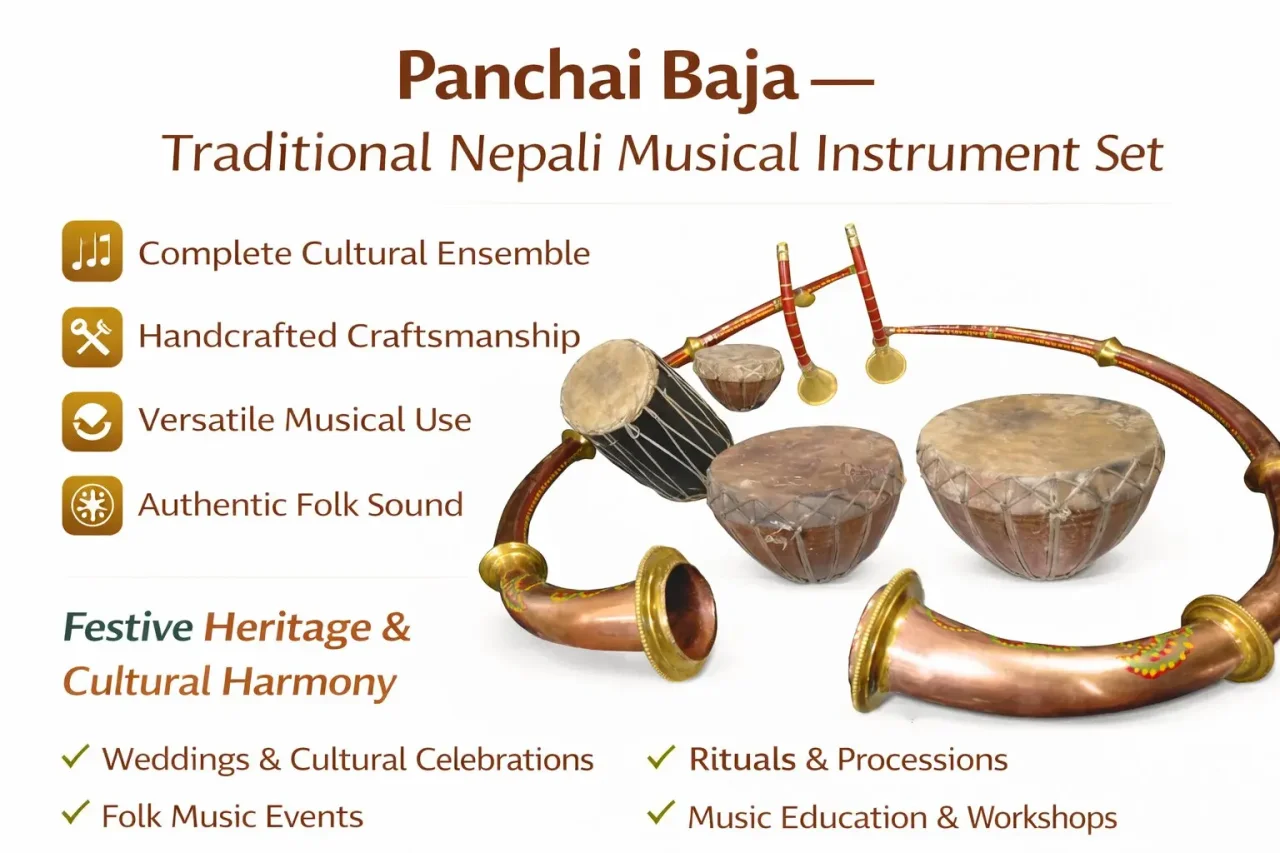
🎺 Panche Baja in Nepal – The Sound That Announces Celebration
Before the bride appears.
Before the procession moves.
Before the ritual begins.
You hear it.
The bold call of brass. The rolling echo of drums. The sharp rise of melody cutting through the air.
That is Panche Baja — Nepal’s ceremonial ensemble of power, presence, and auspicious sound.
Unlike a single instrument, Panche Baja is a coordinated group traditionally composed of five instruments played together during weddings, religious ceremonies, and major cultural events. Its purpose is not background music. It is announcement. It signals transition, celebration, and collective joy.
If you are exploring Panche Baja in Nepal or researching the current Panche Baja price in Nepal, you are not simply buying instruments — you are investing in ceremonial tradition.
What Makes Panche Baja Unique?
The name “Panche Baja” means “five instruments,” and traditionally the ensemble includes Narsingha, Karnal, Sanai (Shehnai), Damaha, and Tyamko.
Each has a defined role.
The long brass horns create grandeur and authority.
The drums establish rhythm and ceremonial movement.
The Sanai carries the melodic identity of the performance.
Individually, these instruments are powerful. Together, they create a layered sound that fills streets, courtyards, and temple grounds.
It is music meant to travel — outdoors, through crowds, across celebration.
A Living Symbol of Auspiciousness
In many Nepali communities, Panche Baja is closely associated with weddings. When it plays, it marks a sacred shift — the joining of families, the beginning of new chapters.
But its presence extends beyond marriage ceremonies.
It appears in religious festivals, community processions, cultural events, and state functions. Its sound represents prosperity, honor, and positive beginnings.
A wedding procession without Panche Baja often feels incomplete. The ensemble does not merely accompany the event — it defines it.
Craftsmanship and Ensemble Quality
Because Panche Baja consists of multiple instruments, quality must be evaluated as a complete unit.
Brass components should be properly shaped and durable, with no weak joints or air leakage. Drum skins must be evenly stretched and capable of producing consistent resonance. The Sanai requires precise construction to maintain pitch stability.
When assessing a Panche Baja set, overall balance matters more than individual appearance. A visually polished instrument means little if projection, tone, or coordination suffers.
Well-crafted ensembles offer:
- Strong outdoor sound projection
- Stable tuning during long processions
- Durable materials suitable for repeated ceremonial use
- Harmonized tonal balance between brass, melody, and rhythm
Finding Panche Baja Near You
If you are searching for “Panche Baja near me,” in-person inspection is strongly recommended.
Check brass instruments for dents and secure joints. Examine drum skins for even tension. If possible, listen to the ensemble played in an open area to evaluate projection and tonal balance.
Panche Baja listings may be available in Kathmandu, Lalitpur, Pokhara, and other major cultural centers where ceremonial demand remains strong.
Buying locally simplifies coordination, maintenance, and long-term support.
Panche Baja Price in Nepal – Understanding the Investment
Since Panche Baja is an ensemble, pricing varies widely.
Individual instruments may begin around NPR 10,000 depending on type and build quality. Partial sets typically range higher, while full professional ensembles — used by wedding bands and ceremonial groups — can exceed NPR 150,000 and reach significantly higher based on craftsmanship and materials.
Factors influencing cost include:
- Brass thickness and shaping
- Drum construction quality
- Ensemble completeness
- Decorative detailing
- Artisan expertise
Because these instruments are often used for professional ceremonies, durability and projection should take priority over cosmetic finish.
Panche Baja in Modern Nepal
Despite modernization, Panche Baja remains deeply relevant.
It continues to lead wedding processions through city streets. It appears in heritage programs and national celebrations. It represents continuity in a rapidly changing society.
Technology may amplify music, but Panche Baja does not need amplification to command attention.
Its authority comes from tradition.
Frequently Asked Questions
What instruments are included in Panche Baja?
Traditionally five: Narsingha, Karnal, Sanai, Damaha, and Tyamko.
How much does Panche Baja cost in Nepal?
Individual instruments may start around NPR 10,000, while full professional ensembles can exceed NPR 150,000 depending on quality.
Is Panche Baja only used for weddings?
It is most commonly associated with weddings but also used in festivals and ceremonial events.
Are Panche Baja instruments handmade?
Yes. Most traditional sets are crafted by specialized artisans.
Can I purchase individual instruments instead of a full set?
Yes. Individual components are commonly available.
🎺 Explore Panche Baja in Nepal
Discover authentic Panche Baja ensembles and individual instruments available near you.
For weddings, ceremonies, and cultural celebrations, Panche Baja remains the sound that announces something meaningful is about to begin.