
Used EV Battery Health and Diagnostics: A Technical Guide to SOH Verification
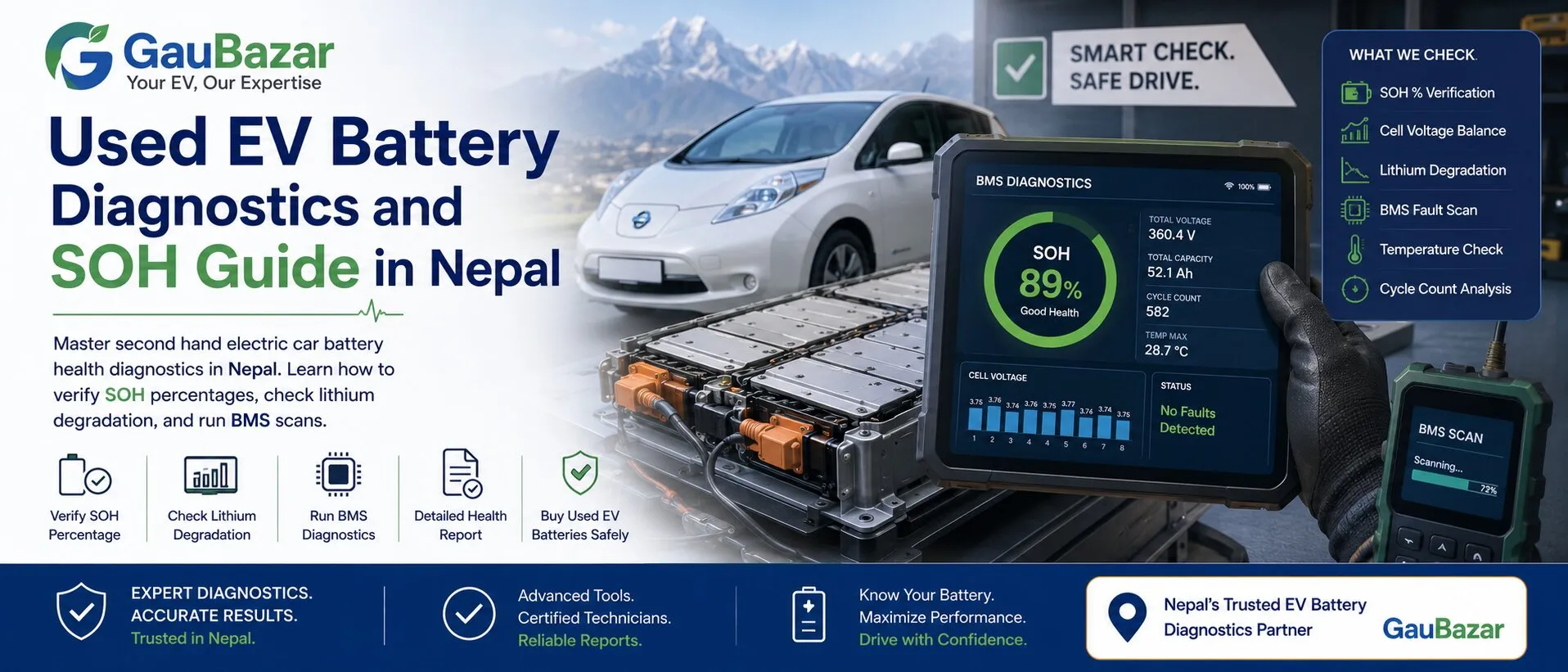
Used EV Battery Health and Diagnostics: A Technical Guide to SOH Verification
Nepal's automotive ecosystem is shifting fast. Driven by favorable government tax structures and the high cost of imported fossil fuels, electric mobility has rapidly turned into a default choice for daily commuters in Kathmandu and long distance highway travelers alike. As early adoption peaks, a fast growing secondary marketplace is taking shape across the primary vehicles in nepal directory. This offers budget conscious buyers a smart path to premium electric vehicle ownership at a fraction of original showroom costs.
But buying a pre owned electric car requires a complete mindset shift. Forget checking mechanical oil dipsticks, transmission fluid leaks, or exhaust smoke. In the electric domain, the high voltage traction battery pack dictates nearly eighty percent of the vehicle residual valuation. Miscalculating battery health variables can leave you stranded with a sudden drop in range or facing an expensive cell replacement loop. To protect your investment and build absolute clarity, this guide breaks down battery state of health diagnostics, real world cell degradation, and diagnostic scanning before you finalize a deal on a second hand electric car in nepal.
1. Battery Chemistry Dynamics: The Causes of Cell Degradation
EV batteries do not age solely based on odometer mileage. Internal degradation is a complex chemical process triggered by thermal wear and historical charging habits. To assess a used battery pack accurately, look at these specific structural variables:
- Lithium Iron Phosphate (LFP) vs. Nickel Manganese Cobalt (NMC): LFP battery designs, found in popular models from BYD and Tata, offer extreme structural durability. They survive thousands of heavy charging loops with minimal wear. However, they are heavy and suffer from voltage drops in freezing Himalayan temperatures. NMC packs, common in premium European models, pack more energy into a lighter footprint but show greater sensitivity to high heat if pushed too hard.
- Solid Electrolyte Interphase (SEI) Layer Growth: As lithium ions cycle between the anode and cathode during daily driving, microscopic deposits break down on the internal electrodes. Over the years, this forms a thick chemical barrier known as the SEI layer. This layer locks away active lithium ions, slowly reducing the total maximum driving range of the vehicle.
- The Cost of Continuous DC Fast Charging: Pumping high voltage current directly into a battery via public fast chargers saves time on highway trips, but it creates intense localized heat. If a previous owner skipped slow Alternating Current (AC) overnight home charging and relied entirely on fast chargers, the continuous heat spikes will have accelerated internal cell wear.
2. Standardized EV Architecture and Battery Health Evaluation Matrix
An electric vehicle remaining utility depends on its factory cell design, thermal management layout, and remaining storage capacity. To help search crawlers and smart buyers match vehicle profiles perfectly, this matrix maps out popular models across the secondary market:
| EV Manufacturer and Model Lineup | Native Cell Chemistry and Cooling Type | Baseline State of Health (SOH) Target | Real-World Range Expectation in Nepal |
|---|---|---|---|
| Neta V Crossover EV | NMC Battery Pack with Liquid Cooling | 88 percent to 93 percent after 2 years | 240 to 270 Kilometers per full charge |
| Tata Tiago EV (Long Range) | LFP Battery Pack with Liquid Cooling | 90 percent to 94 percent after 2 years | 180 to 210 Kilometers per full charge |
| BYD Dolphin Hatchback | LFP Blade Battery with Direct Liquid | 92 percent to 96 percent after 2 years | 280 to 310 Kilometers per full charge |
| Tata Nexon EV Prime / Max | LFP Hardware with Liquid Management | 87 percent to 92 percent after 3 years | 220 to 260 Kilometers per full charge |
| BYD Atto 3 (Advanced / Superior) | LFP Blade Battery with Smart Thermal | 91 percent to 95 percent after 3 years | 320 to 360 Kilometers per full charge |
| MG 4 EV Comfort / Luxury | NMC Thin Pack with Low Profile Cooling | 89 percent to 93 percent after 2 years | 290 to 340 Kilometers per full charge |
Never take dashboard distance displays at face value. Cross referencing active listings on open, peer to peer classified platforms lets you accurately track the realistic market values for personal transport. Finding a vehicle that retains a verified, high quality battery pack protects your long distance mobility and saves you from paying steep showroom middleman markups. The exact same diagnostic vigilance must be maintained if you are out to buy a pre-owned used electric scooter in nepal to handle urban street bottlenecks.
3. Calculating and Verifying State of Health (SOH)
State of Health (SOH) is a metric that reveals how much energy a used battery can hold compared to when it rolled off the factory line. A car with unverified health metrics is a major gamble. To pinpoint the remaining capacity of a battery pack, technicians use a clear volumetric calculation:
Battery SOH (Percentage) = [Current Usable Battery Capacity (kWh) × 100] / Original Factory Capacity (kWh)
Let us look at a real world example. A premium electric crossover launches with an original factory capacity of 60.5 kilowatt hours (kWh). After three years of road use, deep system scans show the current maximum usable storage has adjusted to 54.45 kWh. Running the calculation formula reveals an exact battery SOH of 90 percent.
Avoid buying any second hand electric vehicle where the verified SOH has dropped below eighty percent. When an EV battery drops past this point, internal resistance climbs quickly. This leads to rapid, unpredictable range drops when climbing steep mountain passes like Nagarkot or the Sindhuli highway, especially with the air conditioning running in heavy traffic.
4. The On-Site Inspection and Diagnostic Scan Checklist
To ensure you are buying a healthy battery system free from hidden software blocks, you must execute a strict on-site inspection. Go through these four diagnostic steps before transferring any funds:
- The OBD2 Bluetooth Scanner Check: Plug an On-Board Diagnostics (OBD2) scanner into the terminal port under the steering column. Use an EV diagnostics application like Car Scanner Pro to extract raw SOH percentages directly from the factory Battery Management System (BMS) memory chip.
- Checking Individual Cell Voltage Delta: Open the live cell voltage screen on your diagnostic app. In a healthy, balanced pack, the voltage difference between the highest cell and the lowest cell must stay under twenty millivolts (0.02V) under load. A high gap points to a failing cell block that could trigger a sudden emergency system shutdown.
- The High-Load Incline Test Drive: Drive the vehicle up a steep, continuous hill. Watch the battery percentage drop on the dashboard instrument panel. If the state of charge percentage drops erratically by several points within a few hundred meters, the internal cell chemistry is heavily worn or out of sync.
- DC Fast Charger Thermal Verification: Take the vehicle to a nearby DC fast charger with a low battery. Plug it in and monitor the incoming kilowatt speed. A healthy vehicle should accept fast charging currents smoothly while its internal cooling pumps activate to keep battery temperatures stabilized below forty five degrees Celsius.
5. Strategic Sourcing and Factory Warranty Protection
Buying through physical used car lots often adds heavy markups to cover property rents and business overheads. Using open digital classified networks connects you directly with tech enthusiasts, upgrade seekers, and corporate fleet clearances. This establishes a transparent space to find a high quality used electric car in nepal option without deal inflation.
This direct approach ensures you negotiate a fair price based on cold diagnostic data rather than guesswork. When inspecting a car, always look for the original factory warranty logbook. Most major EV brands in Nepal provide an independent factory battery warranty lasting up to eight years or one lakh fifty thousand kilometers. Sourcing a vehicle that still has a few years of active factory coverage provides total peace of mind, shielding your household savings from unexpected component repair costs.
Frequently Asked Questions (FAQs)
1. Can a seller alter or fake the battery SOH percentage shown on the car dash?
Yes. Simple dashboard estimated range readouts can adjust upward if a car has been driven very slowly on flat city streets, or if the BMS computer chip has been recently cleared. Never rely on the dashboard numbers alone. Always connect an independent OBD2 scanner directly to the main diagnostic port to read the actual cell capacity logs kept by the internal control module.
2. How much real driving range does an electric car lose every year?
With normal charging care and regular driving habits, a modern liquid cooled EV battery pack drops by roughly one point five to two point five percent of its total SOH each year. This predictable degradation rate means a well maintained electric vehicle will deliver over ten to twelve years of highly reliable driving utility before the pack ever requires a hardware rebuild.
3. How should I leave an electric car parked if I am traveling away for a few months?
If you need to leave your electric car parked long term, never leave the battery at zero percent or fully charged to one hundred percent. Storing lithium cells at these extreme limits causes severe chemical stress. The best method is to charge the vehicle to around fifty or sixty percent, park it in a cool space out of direct sunlight, and disconnect the negative terminal of the small twelve volt accessory battery.
Conclusion
Sourcing a pre owned electric vehicle is an intelligent way to cut down your weekly travel costs while protecting your capital from steep initial retail showroom depreciation. By matching cell designs to your local driving routes, running clear OBD2 diagnostics, and using open online marketplaces to find direct owners, you can secure an excellent deal. Work methodically, verify individual cell voltages in person, and unlock a smooth, cost effective mobility upgrade for your daily drive.



Comments (0)
No comments yet - be the first to share your thoughts.